As Chris wrote, we were without “moto” (fire, slang for electricity) here last week. A day or two in the dark isn’t too bad … but by day 5 we were struggling because everything with batteries was dead, too. Eating by candle-light may be romantic, but cooking and washing dishes by candlelight can be disastrous! So, Friday afternoon, a bit spontaneously, we packed up our backpacks with a change of clothes and as many electronics as we could hold (laptop, phones, AA battery charger, AAA battery charger …!). Since our phones and computer were dead we had no way to contact any friends or hotels, so we just set off to town, hoping we could stop by our host’s house in Mombasa to plug in and look up a place to stay. By 5:30 pm we were on the phone with hotels on the south coast, since we had not yet visited the area and thought we might as well use this opportunity. After booking the cheapest (but still decent) room we could find, our host informed us that they actually wouldn’t recommend trying to cross the ferry at rush hour because of the crowds and security. Well, we decided to take a risk, and managed to arrive at the ferry right as they were closing the gate. We safely and quickly traveled there (and back) without incident or loss of anything – God really watched over us.
We managed to get to our hotel before dark via multiple forms of public transportation and then just crashed for the night in an air-conditioned room. The hotel was quite decent for what we paid, and was just blocks from the beach. We didn’t spend much time at the beach, though; it was covered in seaweed and persistent trinket-sellers, so we took advantage of the power to have a “working weekend” of lesson planning, email responding, local phone calling, international calls on Skype, and just a little DVD-watching.
While the whole weekend was nice, a few serendipitous “mini-adventures” made it great. Saturday afternoon we went for a long walk to a grocery store we had seen … only to find out it was still “coming soon.” On the way back we gazed at the road-side kibandas (huts) that sell paintings, figurines, and kangas. After debating about getting a painting (we have wanted one for a while), I expressed that I wished there was a painting of coastal women, not just Masai women, since we wanted something that represents the people that we know here. The artist said he could paint one, so we commissioned the first painting we’ve ever owned!
On Saturday we had passed a sign for a church, and the artist said that he went there and the service was in English. So, Sunday morning we attended the Word of Life Fellowship Church in Diani, and it was awesome! It’s hard to describe … the grounds and building were the quintessential mix of Swahili style and modern but without any pretension, the small congregation was extremely friendly and welcoming, the worship which mixed Swahili and English was gorgeous and genuine, and the preaching was Biblical and heartfelt. God really spoke to me through his word and the message on Philemon (“PHIL-a-mon” they say). There were a couple American missionaries and a few Germans associated with the church, but otherwise it was very Kenyan and welcomed people from town and villages alike. It was great to see God working in this community and we were glad to be a part of it for one day.
We went away for the weekend to recharge our batteries – literally AND figuratively! – and as we returned home I was contemplating the ways in which I had been asking God for power. The service ended with a prayer that said, “God, there is no power … other than your power.” Chris and I both laughed a bit, but I think I had come to the conclusion that the weekend was going to have a happy ending whether or not there was power when we returned to Ribe. In fact, I felt God used this uncomfortable situation to bring us closer to him … so we were happily (ecstatically?) surprised when, 30 minutes before we would arrive home, we receive a text message from our host saying power was back! Hallelujah! A happy ending that included power was yet a little happier.
Tuesday, February 9, 2010


Sunday, January 31, 2010
Power out in Ribe
You may (or may not) have noticed our slight absense, and perhaps noticed my (Chris) status updates on twitter/facebook... there was a power black-out all last week. We tried to roll with it and further experience how many of the locals here live (we've now done water shortages and extended time without power, and pray that they don't happen at the same time). However, I wonder if it is even more difficult for us than others around us for the fact that we did not grow up learning how to deal with it!
Exactly one week ago from this moment was not unlike this evening; we returned to Ribe from visiting friends and probably spent a little time online. We had bought meat and other cold items, like yogurt and stored them in the fridge. Then, Monday morning we woke to no electricity! We were just recovering from some upset stomachs from eating suspect foods during the 3 day power outage the week before, so although we were hoping to save the meat a couple days since we enjoyed some over the weekend in Mombasa, we were not going to risk this food going bad!
Monday night, we fixed up some BBQ ribs on a Kenya-style grill. Yes, a charcoal jiko with a wire grate on top. Lesley also made the BBQ sauce from scratch and it was amazing!
Exactly one week ago from this moment was not unlike this evening; we returned to Ribe from visiting friends and probably spent a little time online. We had bought meat and other cold items, like yogurt and stored them in the fridge. Then, Monday morning we woke to no electricity! We were just recovering from some upset stomachs from eating suspect foods during the 3 day power outage the week before, so although we were hoping to save the meat a couple days since we enjoyed some over the weekend in Mombasa, we were not going to risk this food going bad!
Monday night, we fixed up some BBQ ribs on a Kenya-style grill. Yes, a charcoal jiko with a wire grate on top. Lesley also made the BBQ sauce from scratch and it was amazing!

We also ate the yogurt much quicker than planned, and the other meat was ground beef, which we browned a bit each night until we made spaghetti on Wednesday night.
Otherwise, in the evenings, we pretty much just watched the flames jumping on the candles, talked quite a bit more than usual, and played cards. Check out the empty peanut butter jar hurricane Lesley devised with a little sand in the bottom to hold the candle up.

Wednesday, January 20, 2010
Renovation of the old Methodist Church building for the Women’s Sewing Project
This is a little story about how things work in Ribe. Here is warning that it is a bit long and some parts are overdue, but I wanted to share that the women have begun their project, and that finally occurred recently. It is not a bad thing; it is just not what we expected.
The primary purpose of the November visit from Brydie, the Director of Project Kenya, was to deliver funding and launch a sewing project for the Methodist church women. The church has a fairly new church building, and the old building was identified as a good place for this project to “create employment and eradicate idleness” and “empower and encourage the women in the church”, as well as “encourage other groups around in community developments” according to the proposal.
We had a meeting in the old church building to launch the project, and Brydie accompanied a couple of the women to purchase a few manual/foot pedal Singer machines and sewing supplies.

 I (Chris) was assigned the task of managing the renovation project with the remaining funds, to be completed as soon as possible, which I personally feel I handled with mixed results due to differing cultural approaches. For example, rather than ordering and waiting for delivery of cement, we borrowed bags of cement from the school construction site, which I understand due to the time frame. However, I am still trying to pin down the return of that cement with regard to the funding and when the school needs it.
Without further adieu, here goes some of the renovation:
I forgot the camera on the morning of the first day, so I’m sorry I don’t have truly “before” pictures; you’ll just have to imagine… By the end of the first day, the front entrance of the church was blocked up, since a side door is being used. I was just focused on the end goal of the project, but our friend, who is a pastor in Nairobi, pointed out the unintended symbolism of this photo when I was showing him the project over Christmas.
 The windows were also reduced, raising the level of their sill in order to enhance security, although I found it a little sad when one of the younger guys working on it with us jokingly told a friend of his who stopped by that we were converting it into a jail.

I think we had a goal of doing it within one week, or at least I did mentally, but Tito spiced things up a bit when on Friday he actually promised the women that we'd turn it over to them on Sunday. Therefore, we still had quite a bit of work, and then suddenly we had a deadline!
Now, it is not unusual for the men to work on Saturday, and I have joined them on occasion, but that was Lesley’s birthday, the harambee (fundraiser) we wrote about before, and a wedding we managed to visit as it wound down. Additionally, there was a different wedding at the church that weekend, and I think most of the workers were going to either the harambee or one of the weddings as well. Therefore, we didn't meet the Sunday deadline, but on Monday, we made a hard push to set up the sewing project by that night with work on several fronts:
Manufacturing a metal security door by welding parts of two doors together to make it larger than either one had been:
 Blocking up the large gap between the wall and roof:
 Finishing whitewash painting the interior walls:
 Fixing stools to be used at the sewing tables (didn't realize I cut off his head while trying to center the stools in the photo!):
 & electrical work!
Unfortunately, welding the door took the full day, and the electrician required some materials from Mombasa. Accordingly, it seemed to me that they would finish without my presence the next day since Lesley and I were headed to Mombasa ourselves for a few errands including shipping Christmas gifts to our families. However, the electrician underestimated the amount of wiring and they texted me in town to pick up more. Other tasks such as completing the construction of a table for measuring and cutting their fabric also took longer to complete than anticipated.
The next day, we completed the bulk of the renovation such that in addition to the front entrance being blocked and plastered, the building security is enhanced by the window adjustments and metal door, and also a wood partition wall inside to create a tailoring area and a teaching sewing area. I am still pretty impressed by all that was accomplished in about a week and a half.


 All that remains today are some window grills I designed with the materials available; they were requested to further increase the security (the boys around here can apparently get quite mischievous – I was surprised they felt we needed to block up the gap between the walls and the roof!) Eight more grills require welding and painting, and then all of them will be bedded into the exterior of the walls. They are obviously not as urgent; just a to-do item that is now being bumped for other tasks lately. Besides that, the women will probably want to acquire some fans since all of our other security enhancing has reduced airflow through the building.
 We turned the building over to the women the following weekend (December 12th I believe), thinking they would get to work making school uniforms for the beginning of this new school year, since “providing clothing/uniforms at a cheaper rate and help in eradicating poverty” is one of the goals. However, the Christmas time, combined with their wedding season, seems to have overruled that taking place. Besides, perhaps the women themselves never planned to try to provide uniforms this term.
After ringing in the New Year, I kept waiting to see them begin until Tito explained that they wanted to mop and clean up the place a bit more after all of our construction. Yet, they (wisely) decided to wait due to the water shortage we were experiencing when the regional pump house broke down and had to wait for repair.
The women must have heard that we were looking forward to their start, because they came to get us on the first day they were going in to set up:


 We also stopped by a couple days later and found them taking measurements of a few students:
 Some additional VERY EXCITING news about these women, and this project, is that many of the women also comprise the church’s choir. Well, at the same time as we were working so hard to renovate the old church building, they went to Nairobi for a choir competition and took second place! This positioned them to recently become one of the few, if not only Kenya National Choir (we still struggle to get complete information on things like this). Therefore, if the President wants to use them at an event, they would go perform for him! Additionally, some people came “to see where these women are from” and reportedly had a donation to help them begin some sort of project. Now this is where I am really excited that we have helped them help themselves already: Upon learning that they have already started on this sewing project, those people have apparently gone back to Nairobi seeking to double their donation to the Ribe Methodist Church Women.
The primary purpose of the November visit from Brydie, the Director of Project Kenya, was to deliver funding and launch a sewing project for the Methodist church women. The church has a fairly new church building, and the old building was identified as a good place for this project to “create employment and eradicate idleness” and “empower and encourage the women in the church”, as well as “encourage other groups around in community developments” according to the proposal.
We had a meeting in the old church building to launch the project, and Brydie accompanied a couple of the women to purchase a few manual/foot pedal Singer machines and sewing supplies.
I (Chris) was assigned the task of managing the renovation project with the remaining funds, to be completed as soon as possible, which I personally feel I handled with mixed results due to differing cultural approaches. For example, rather than ordering and waiting for delivery of cement, we borrowed bags of cement from the school construction site, which I understand due to the time frame. However, I am still trying to pin down the return of that cement with regard to the funding and when the school needs it.
Without further adieu, here goes some of the renovation:
I forgot the camera on the morning of the first day, so I’m sorry I don’t have truly “before” pictures; you’ll just have to imagine… By the end of the first day, the front entrance of the church was blocked up, since a side door is being used. I was just focused on the end goal of the project, but our friend, who is a pastor in Nairobi, pointed out the unintended symbolism of this photo when I was showing him the project over Christmas.
The windows were also reduced, raising the level of their sill in order to enhance security, although I found it a little sad when one of the younger guys working on it with us jokingly told a friend of his who stopped by that we were converting it into a jail.
I think we had a goal of doing it within one week, or at least I did mentally, but Tito spiced things up a bit when on Friday he actually promised the women that we'd turn it over to them on Sunday. Therefore, we still had quite a bit of work, and then suddenly we had a deadline!
Now, it is not unusual for the men to work on Saturday, and I have joined them on occasion, but that was Lesley’s birthday, the harambee (fundraiser) we wrote about before, and a wedding we managed to visit as it wound down. Additionally, there was a different wedding at the church that weekend, and I think most of the workers were going to either the harambee or one of the weddings as well. Therefore, we didn't meet the Sunday deadline, but on Monday, we made a hard push to set up the sewing project by that night with work on several fronts:
Manufacturing a metal security door by welding parts of two doors together to make it larger than either one had been:
Blocking up the large gap between the wall and roof:
Finishing whitewash painting the interior walls: Fixing stools to be used at the sewing tables (didn't realize I cut off his head while trying to center the stools in the photo!): & electrical work!
Unfortunately, welding the door took the full day, and the electrician required some materials from Mombasa. Accordingly, it seemed to me that they would finish without my presence the next day since Lesley and I were headed to Mombasa ourselves for a few errands including shipping Christmas gifts to our families. However, the electrician underestimated the amount of wiring and they texted me in town to pick up more. Other tasks such as completing the construction of a table for measuring and cutting their fabric also took longer to complete than anticipated.
The next day, we completed the bulk of the renovation such that in addition to the front entrance being blocked and plastered, the building security is enhanced by the window adjustments and metal door, and also a wood partition wall inside to create a tailoring area and a teaching sewing area. I am still pretty impressed by all that was accomplished in about a week and a half.
All that remains today are some window grills I designed with the materials available; they were requested to further increase the security (the boys around here can apparently get quite mischievous – I was surprised they felt we needed to block up the gap between the walls and the roof!) Eight more grills require welding and painting, and then all of them will be bedded into the exterior of the walls. They are obviously not as urgent; just a to-do item that is now being bumped for other tasks lately. Besides that, the women will probably want to acquire some fans since all of our other security enhancing has reduced airflow through the building.
We turned the building over to the women the following weekend (December 12th I believe), thinking they would get to work making school uniforms for the beginning of this new school year, since “providing clothing/uniforms at a cheaper rate and help in eradicating poverty” is one of the goals. However, the Christmas time, combined with their wedding season, seems to have overruled that taking place. Besides, perhaps the women themselves never planned to try to provide uniforms this term.
After ringing in the New Year, I kept waiting to see them begin until Tito explained that they wanted to mop and clean up the place a bit more after all of our construction. Yet, they (wisely) decided to wait due to the water shortage we were experiencing when the regional pump house broke down and had to wait for repair.
The women must have heard that we were looking forward to their start, because they came to get us on the first day they were going in to set up:
We also stopped by a couple days later and found them taking measurements of a few students:
Some additional VERY EXCITING news about these women, and this project, is that many of the women also comprise the church’s choir. Well, at the same time as we were working so hard to renovate the old church building, they went to Nairobi for a choir competition and took second place! This positioned them to recently become one of the few, if not only Kenya National Choir (we still struggle to get complete information on things like this). Therefore, if the President wants to use them at an event, they would go perform for him! Additionally, some people came “to see where these women are from” and reportedly had a donation to help them begin some sort of project. Now this is where I am really excited that we have helped them help themselves already: Upon learning that they have already started on this sewing project, those people have apparently gone back to Nairobi seeking to double their donation to the Ribe Methodist Church Women.Saturday, January 9, 2010
Christmas & Safari
We had a really nice holiday season even though we were away from home. After the wedding we went up to Nairobi to stay with our friends Eda and Albo and their two sons (baby Seo arrived shortly after we last visited them in August!). We had a relaxing Christmas Eve and Christmas, got to see a movie in a theater, played board games, got some shopping done, visited with a friend, Julie, who is an American teacher, visited with Laura and her parents (Kenyan family friends), and generally took a vacation! We neglected to take pictures, though, since our batteries were dead :-(. This was my (Lesley) first Christmas away from my family, but Eda’s family took us in as their own and we did Skype with family members. We particularly enjoyed the chilly weather (similar to a California winter) and being in the presence of strong Christians and good friends.
The day after Christmas we took off on our safari … though there were a couple of minor mishaps when we first arrived and on the way home, all in all it was a great trip. We visited Masai Mara and Lake Nakuru, and spent most of the time doing game drives. We saw all the main animals except leopards, which are notoriously hard to spot. Here are the highlights, in roughly chronological order:
A cheetah on the chase (even though we couldn't see the running behind some brush, here the cheetah is after sadly not catching any of the antelope).


Zebra herds patiently waiting to cross the road:







Having an unexpectedly romantic, candle-light dinner at the Mara Hippo Lodge:

"Honeymooning" lions - yes, we can actually attest to it!


The beauty of Lake Nakuru:

A rhino crossing the road right ahead of us - there was tall brush on both sides of the road, and we were looking in the trees for a chance to see leopards, so this rhino just like appeared right in front of us and was already on the other side of the road as you see by the time we got the camera up.

Impala herds – they are separated into the females with one male, and then a nearby heard of the rest of the males. Then, we saw a male challenging the other males in his herd in preparation to challenge the male with the females!

A giraffe herd very close around us, with two neckling (neck wrestling) though it looked like just for fun/practice fighting.


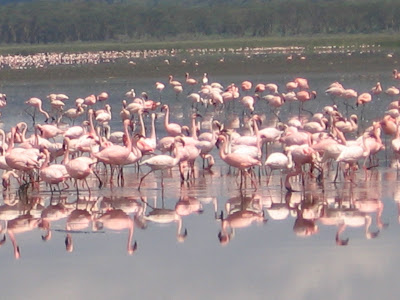
Flocks of flamingos in Lake Nakuru:
The day after Christmas we took off on our safari … though there were a couple of minor mishaps when we first arrived and on the way home, all in all it was a great trip. We visited Masai Mara and Lake Nakuru, and spent most of the time doing game drives. We saw all the main animals except leopards, which are notoriously hard to spot. Here are the highlights, in roughly chronological order:
A cheetah on the chase (even though we couldn't see the running behind some brush, here the cheetah is after sadly not catching any of the antelope).
A lion-buffalo face-off (here is a brave buffalo from the herd trying to run off the lionesses), and a male relaxing in some brush not too far away – probably associated?
Visiting a local Masai village (Chris on the left, in the purple - just in case you can't tell!)
Zebra herds patiently waiting to cross the road:
An elephant herd (with a little baby)... not waiting to cross the road!
A lion crossing the road to join another lying in the brush.
Driving all the way to the Tanzanian border (where the Masai Mara becomes the Serengeti) and seeing a rare Masai giraffe just across it.
Hippos in the Mara River:

A crowned crane dancing for another right in front of our van:
A crowned crane dancing for another right in front of our van:
Having an unexpectedly romantic, candle-light dinner at the Mara Hippo Lodge:
"Honeymooning" lions - yes, we can actually attest to it!
A cheetah couple relaxing, and then when they got up, it appears one is pregnant.
The beauty of Lake Nakuru:
A rhino crossing the road right ahead of us - there was tall brush on both sides of the road, and we were looking in the trees for a chance to see leopards, so this rhino just like appeared right in front of us and was already on the other side of the road as you see by the time we got the camera up.
Impala herds – they are separated into the females with one male, and then a nearby heard of the rest of the males. Then, we saw a male challenging the other males in his herd in preparation to challenge the male with the females!
A giraffe herd very close around us, with two neckling (neck wrestling) though it looked like just for fun/practice fighting.
Flocks of flamingos in Lake Nakuru:
ps. We just have a basic digital camera; no special zoom ... we really were that close! And we have hundreds more pictures if you like that stuff ... just ask us when we get home.
Tuesday, January 5, 2010
Exciting week (part II): A Ribe Wedding
… Friday night, the 18th, began the long-anticipated wedding in Ribe. We had planned our holiday schedule around the wedding and our host family was coming up here to celebrate, since the groom is Tito’s cousin/nephew of some sort (extended families here get very extended, and quite complicated).
 Mysara (11), Asma, and Tawfidah (7) all dressed up for the wedding.
 The "bibi harusi" (literally, wedding woman) and "bwana harusi" (wedding man) with their attendants and pastor.
 The bride and groom exiting the church, while the congregation sings and dances a wedding song.
 Biryani cooking in huge pots
One thing that surprised us was that there appeared to be party planners who took care of the decorating, tents, chairs, flowers, etc. In the US we would never dream of cooking that much food for a wedding, but would likely do our own decorating if we were on a tight budget. However, here they cook their own food but hire others to decorate! I think there is a correlation to how we live our lives, though – these coastal women are fantastic cooks but don’t have very decorated homes, whereas in the US it’s rather vice versa.

I should give a little background information about weddings in Kenya, since we have learned a lot more about them since we visited part of a wedding a few weeks ago. I still don’t feel I understand how all the details work, but there are traditional weddings and official/religious weddings. In this part of Kenya it seems common for a couple to first have a traditional wedding, which really just means that each person’s parents agree to the union and they start living together and probably having children. (side note: Kenyans don’t think you’re really married until you have kids. Thus they often think we are brother/sister, or that we must have children back in the US.) I don’t think there is much of a ceremony for a traditional wedding, though possibly some dowry might be paid.
An official/religious wedding is held in a church (or mosque, I presume?) and involves going all-out to throw a party for basically everyone you know. Part of the ceremony includes signing a marriage license, so the union is officially recognized by state law and the children and wife are taken care of in case anything happens to the husband. We have learned that the reasons people don’t always have official weddings to start is because they either want to have a “trial marriage” (i.e., like living together, see if they are compatible) or because they don’t have the money for a marriage license and big wedding.
In this case, the bride and groom had been traditionally married for about 10 years and they had three daughters. The wedding festivities started a few days in advance with many extended family members coming into town to do preparations. The day before the wedding, the women do a ridiculous amount of cooking and prepare a large feast for a party that night. All the groom’s family and friends (about 200 people) gathered at his village and had pilau and danced to the music of a live band and DJ. Its closest comparison in the US would be a rehearsal dinner plus bachelor party. I was told that the bride and her family were having a similar party at their home. At one point a group of women from the groom’s side took a bag of presents to the bride’s side. The bag contained personal and household items for the bride to use in setting up her home, so it seems her party could be compared to a bridal shower plus bachelorette party! The gifts they brought her may be considered part of the dowry, but it was probably not the dowry in its entirety.
(Side note: Dowries are still very common in Kenya, and they are either given to the bride’s father (Christians) or the bride herself (Muslims). Asma, our host, is Muslim and obviously thinks they have a better deal! Either cash or goods are given – the groom and recipient decide on a price (or the recipient names one!), and if necessary, the groom can pay in installments. Livestock is a common form of payment to the father, and I learned that 4 cows is a decent dowry (worth 120,000 shillings, or $1,600), but can even go up to $10,000! If the dowry is given to the bride, she might get furniture or other things for the home plus some cash to do some personal shopping.)
The party went late on Friday night, and most of the time the women and men were separated. I (Lesley) got pulled on to the dance floor a number of times by the older ladies who thought it was hilarious to teach me to dance, while unfortunately Chris was stuck with a group of men promising some of the food that never arrived (the men were distracted by the local brew). Finally tired Lesley and hungry Chris found each other and left “early” at around midnight. Others stayed up most of the night dancing and then enjoying mountains of mahambri (triangular shaped sweet bread – like mild doughnuts) in the morning, another wedding tradition. The village women even sent up a tray of mahambri to our house!
Mysara (11), Asma, and Tawfidah (7) all dressed up for the wedding.We were told the wedding started at around 10 on Saturday … so we left the house at 10:30 and found that by 11ish the church was filling up but the wedding was nowhere near starting. The bride arrived around 12 or 12:30 (everyone seemed like this was completely normal, not her being late) and then the ceremony lasted until 2:30. The ceremony had a lot of singing and dancing performances by the youth group, the women’s choir, and all the women who lived in the bride and groom’s village. The couple said their vows, exchanged rings, and to the complete embarrassment of the bride, even kissed (which was particularly amusing since they have been together for 10 years and have 3 kids … but Kenyans just aren’t big on PDA.) There was also something about popping two balloons, but we didn’t understand that, so we each came up with our own creative relationship-related analogies!
The "bibi harusi" (literally, wedding woman) and "bwana harusi" (wedding man) with their attendants and pastor.The bride and groom exiting the church, while the congregation sings and dances a wedding song.After the wedding everyone headed to the village to begin the party, but we were pretty hungry and knew that the food would be a while in coming, so we ducked by our house on the way for a snack and rest. We got to the reception later and discovered we missed some traditional dance performers but were in time for some delicious biryani (goat stew with rice) and the rest of the festivities. It was rather impressive to watch the men cook the food in huge pots and a team of about 30 young men running around serving everyone on big trays. There were probably 500 people there – I know they had to borrow dishes from everyone in the village!
Biryani cooking in huge potsOne thing that surprised us was that there appeared to be party planners who took care of the decorating, tents, chairs, flowers, etc. In the US we would never dream of cooking that much food for a wedding, but would likely do our own decorating if we were on a tight budget. However, here they cook their own food but hire others to decorate! I think there is a correlation to how we live our lives, though – these coastal women are fantastic cooks but don’t have very decorated homes, whereas in the US it’s rather vice versa.
The red carpet and head tent in the middle of the village (groom's house seen behind tree)
Following the food came the time to give presents. The bride and groom sat in the head tent and people lined up to individually to give them their present – kind of like a receiving line plus gifting. It’s funny how gift giving in the US is done behind the scenes and surreptitiously at weddings – I don’t know if I’ve ever seen a guest hand a present directly to the newlyweds (though I suppose pre-wedding showers are the opposite). After presents, the couple walked along their red carpet to the cake table, where they pretended to a cut a cake (couldn’t tell if it was a real cake or why they pretended) and then all the guests were served bite-sized, pre-wrapped pieces of dry cake and certain family elders were given the display cakes (Chris thinks the cakes must have been real and this is another tradition we don’t quite understand). A number of guests left at this point but we stuck around hoping for more dancing.
Soon we saw a band starting to set up and got excited, but our hosts told us that the dancing wouldn’t begin for a few hours. Everyone takes a bit of a rest in the afternoon (since the night before they went to bed very late, if at all), and then in the evening the bride and groom do a first dance to kick off another late-night party. So with this in mind we headed home for a rest and our weekly Skype date with Lesley’s family. However, after changing out of wedding clothes and relaxing with our host family, we all crashed for a bit of a nap and then didn’t feel like going back down the hill again. We later learned that Asma actually woke up around 2 am and decided to rejoin the party! Needless to say, most of Ribe slept the entire next day.
For us, the wedding was quite a cultural experience, but unfortunately there was a lot we didn’t understand and in which we couldn’t fully participate. Most of the people in the village who typically take us under their wing to explain things were pretty occupied with arranging the festivities, feeding and entertaining 500 people, and cleaning up after them! Nevertheless, we extended congratulations to our friend Dicky, his “new” wife and their families :-)
Ps. I may not be entirely accurate in my understanding of Kenyan weddings, or this may only be applicable to the coastal area where we live. So please don’t make any generalizations, and feel free to correct me if you happen to know more than I do!
Subscribe to:
Posts (Atom)