I apologize for not writing in a while - school has kept me very busy! Here is a taste of my life at Ribe Primary ...
Scene: School room with dusty, cracked concrete floors. 35 two-seater wooden desks in four rows, each labeled “Supported by World Vision” or “CDC.” A wooden door propped open with a rock, a blackboard with remains of yesterday’s science and last week’s math. Four windows on each wall, sporting bent horizontal bars and broken mesh, the last efforts at security and sanity. Two torn sheets hanging above the openings, one twisted and shoved between the bars, the other flapping in the persistent breeze.
In the four rows, 58 heads with short-cropped black hair rise above 58 short-sleeved, collared, sea-green cotton shirts. Beneath the wooden desks, 32 khaki shorts and 26 khaki skirts have been patched, hemmed, and re-fastened after growth spurts and active childhoods. 116 feet, 32 bare and 84 adorned with plastic flip flops, shuffle around the dust and each other. Outside the windows, 8 more dark heads can be seen hurrying past and shuffling in the open door as a metal bell, hanging from the roof’s awning, is struck twice by their classmate.
Enter the teacher. Arms full of lesson plans, plastic-covered text books, red pens and chalk. A pupil nearest the door leaps up and says, “may I help you madam.” Pupil takes books and writing tools, turning around an empty desk and putting the items atop. 15 pupils jump up as the teacher enters, 30 others stand as usual, 13 take their time and 8 remain standing from their recent arrival.
“Good morning, class,” the teacher greets them.
“Good morning madam,” they say in unison. “How are you madam.”
“I am fine, thank you,” replies the teacher. “And how are you?”
“We are fine madam. Thank you madam.”
“You may be seated,” says the teacher, always to her private amusement that she should receive a standing greeting upon each entrance.
“Thank you madam. Welcome madam,” is the reply, and they shuffle again into their desks.
Thus begin my mornings at Ribe Primary School, where I am teaching Class 7 English and Class 6 mathematics (“maths”). It was a strategic decision to place me in these classes, since the students must have learned enough English to understand me, yet be young enough that they are still learning, not just preparing for the exit exam. We have recently begun Term 3, the last of the school year terms which runs September through November. So far, at six weeks in, I am still adjusting, but time is going so quickly and I am enjoying this great learning opportunity.
For the most part, the students are obedient and hard-working. They struggle because of the large class sizes, lack of educational support material, and life circumstances that make school work difficult. In Class 7 there are up to 72 students, and in Class 6 maths, up to 88. Attendance varies significantly and students may miss school due to illness, caring for family members, traveling to funerals, harvest time, water shortages, and a host of other reasons. Primary education is now free at public schools in Kenya, but there are still times when the students must pay fees, such as to “sit for” exams, which deter them as well.
Though the students may struggle, the teachers work hard to do their best. I have been impressed by the teachers, many of whom are experienced veterans. In the staff room we have enjoyed discussing the differences between Kenyan and American education and helping each other improve our Kiswahili and English. While we disagree about methods of discipline (caning is used frequently here), I have still been brought into the staff “family” as we are all in the same challenging situation together.
Some of my favorite moments at school include getting to know the other staff members and the times when I have an opportunity to present a creative lesson or work with a student one-on-one. Although the students are disciplined, they have a lot of energy and love to burst out into laughter when I’m willing to laugh at myself (which, in a new culture, is a pretty essential skill!). I have actually really enjoyed teaching both English and math because it gives me some variety and because I get to work with different ways of thinking and teaching. The curriculum is very structured but pretty good once I figured out how it works to culminate in the Class 8 exit exam. As a new teacher here, it’s also nice to have something to guide me so I know my teaching isn’t way off track.
Some of the toughest things are when I am dealing with administrative or scheduling procedures that would be forbidden or at least frowned upon in the US, and when I have literally hundreds of assignments to grade. Sometimes teaching English is frustrating because the students are still very much learning it as a foreign language even though it is supposedly the only language allowed on campus. Kiswahili and the local Kiribe can be heard in the assembly, staff room, classrooms, playing field, etc., and even the English exam questions are riddled with grammar and language mistakes. At first getting students to participate was hard, but as our communication increases they feel more comfortable with me and I am learning what teaching methods motivate them to respond.
Overall I am very happy to be able to jump right in and teach this term, though I am not sure how my time will be allotted as I start to do more work on developing the new library. I feel like there are so many things I want to do in the classrooms, with the staff, and with the school as a whole that I could easily get burned out if I don’t take my time. Please keep me, the staff, and students in your prayers as we hope to be planting seeds of knowledge, skills, and faith this term and throughout the year.
Thursday, October 15, 2009


Monday, October 12, 2009
Futboli
We’ll finally share some pictures of Chris as a Kenyan footballer… they are quite overdue, since they are from that first weekend’s game. The RYDAS F.C. are a fun group of guys who I had already really enjoyed joining their practices. As we told Lesley’s mom, we thought the team name was simply like “riders” but with the somewhat unique Kenyan spelling that we see sometimes. We did not recognize at first that it is the acronym of the Ribe Youth Development Association we have partnered with in coming here! So, it is quite fitting that I joined them and not another team.
 However, I apparently did not get fouled enough to merit more play; we’ve been hoping to get more pictures of me playing, but the guys want to win. Therefore, a few of the players and I have not gotten to play. I’ve begun joking with Tito that I think we need to be winning by 3 goals for me to have a chance to play again. Well, this past week, we did not have game a game (thankfully, since we spent the weekend in Nyali again), but the weekend before, the guys did win 3-0! Just my luck that it was the week that I had been sick with a bit of a cold/minor flu (they seem to call everything with a sniffle or cough the flu though), so I hadn’t practiced all week and was not prepared to play.
 Fortunately, I had caught a ride to the game with Tito, or else I would not have gone, because the game was in the next town over, which the team walks over an hour each way to get there! The other time we had a game there, I walked with them, did not play, walked back with them, and was completely exhausted. I can’t imagine how tired the guys who played most of the game must have been! I would not have made it when still trying to kick that cold, but was sure glad I went in Tito’s car because it was great fun to celebrate with the guys.

Even the goals were quite exciting! Here is a brief recap: well, we missed the first one since we arrived late (after helping a truck with Obama’s “Yes We Can” slogan on it with a flat tyre, so sadly “no they couldn’t.”) However, it was scored by one of the guys I’ve gotten to know a bit, so it was great to congratulate him at halftime. The second goal occurred when our striker was tripped in the box and blasted the penalty kick past the goalie. Then, in the second half, Jimmy, our captain who invited me to play with the conversation I shared in the blog and I’ve also gotten to know a fair bit, took a great shot from the corner of the penalty box across to the far post… barely too far rebounding off the post to another attacker who one-timed it out of the air over the goal. I was jumping up and down on the sideline in excitement and then disappointment. Just a little bit later, Jimmy’s efforts were rewarded with a beautiful head ball to the upper corner of the goal on a cross from the corner. It was all so fun to watch… I’ll continue enjoying practices and let you know if I play in a game again.
However, I apparently did not get fouled enough to merit more play; we’ve been hoping to get more pictures of me playing, but the guys want to win. Therefore, a few of the players and I have not gotten to play. I’ve begun joking with Tito that I think we need to be winning by 3 goals for me to have a chance to play again. Well, this past week, we did not have game a game (thankfully, since we spent the weekend in Nyali again), but the weekend before, the guys did win 3-0! Just my luck that it was the week that I had been sick with a bit of a cold/minor flu (they seem to call everything with a sniffle or cough the flu though), so I hadn’t practiced all week and was not prepared to play.Fortunately, I had caught a ride to the game with Tito, or else I would not have gone, because the game was in the next town over, which the team walks over an hour each way to get there! The other time we had a game there, I walked with them, did not play, walked back with them, and was completely exhausted. I can’t imagine how tired the guys who played most of the game must have been! I would not have made it when still trying to kick that cold, but was sure glad I went in Tito’s car because it was great fun to celebrate with the guys.Even the goals were quite exciting! Here is a brief recap: well, we missed the first one since we arrived late (after helping a truck with Obama’s “Yes We Can” slogan on it with a flat tyre, so sadly “no they couldn’t.”) However, it was scored by one of the guys I’ve gotten to know a bit, so it was great to congratulate him at halftime. The second goal occurred when our striker was tripped in the box and blasted the penalty kick past the goalie. Then, in the second half, Jimmy, our captain who invited me to play with the conversation I shared in the blog and I’ve also gotten to know a fair bit, took a great shot from the corner of the penalty box across to the far post… barely too far rebounding off the post to another attacker who one-timed it out of the air over the goal. I was jumping up and down on the sideline in excitement and then disappointment. Just a little bit later, Jimmy’s efforts were rewarded with a beautiful head ball to the upper corner of the goal on a cross from the corner. It was all so fun to watch… I’ll continue enjoying practices and let you know if I play in a game again.
Wednesday, October 7, 2009
Wildlife...
We are looking forward to doing a safari sometime this year, but until then, here is a bit of the wildlife we see. Part of living in a rural area is that there are plenty of creatures to keep us company! Here are some of our friends:
Mbwa (dog) – Tito apparently bought him with a couple others many years ago, but he is the only one left and is more like a stray that lives at our house … we give him leftover food occasionally and he sometimes growls at night to protect us from whatever is out there, but mostly he lies around all day. We just called him “Mbwa” for a while until we found out he has a couple other names: “Rhino” and “Marty,” depending who you ask.
Ng’ombe (cow) – We see small herds of like a dozen or so in town being guided down the streets by their herder to graze, etc. However, some people, including Tito, keep a few in stables and feed them as shown in the picture. On our third day in Ribe, one of the guys who lives and works on Tito's shamba (farm), Masudi, came to our house and motioned something about the cows. We had the impression we would milk them, and excitedly put on boots and headed down the hill with him. When we got there, he motioned to some gloves, which Chris put on while Masudi explained in Swahili that was completely lost on us. Then he pointed to a large serrated blade, and made a cutting motion. We looked at each other in pure horror and thought that we were about to help kill a cow. After a few moments of whispering furiously to each other about what to do, Chris began taking the gloves off asking him to demonstrate. Masudi picked up an armload of nearby brush clippings, fed it to the cows, and urged us to do the same. We think it turns out that he had explained that the equipment was for cutting down ndizi (bananas), not killing the cows. Phew, one animal slaughter avoided.
 (a relieved Chris with Masudi)
Nguruwe (pig) - One of the duka (shop) owners also has pigs including this mama and her babies that we've been able to peek in on since they were less than a week old!
Mbuzi (goat) – They are around town grazing, often tied to tree stumps, and can be quite loud - sometimes we think it is a child crying for help! There are usually 4-5 near the school each morning.
Kuku na kifaranga (hen & chicks) – These also roam around town and the school, and we enjoy seeing the little baby chicks run around except when they dart across in front of me and I have to watch my step!
Kijusi (lizard) – In this quiet rural life, one of our typical evening activities was sitting after dinner and watching the geckos. At first we were a little creeped out that so many lived in our house, but when we realized that they ate mosquitoes they became our best friends. Some of the regulars include Tom, Beck, and Charlie, whose names are derived from the founding missionaries of Ribe, as well as one that blends in with the door that we call (GI) Joe, a small guy called Tiny Tim, and the even smaller Junior. Yes, we do realize they are very unlikely to be the same geckos from night to night, but they have became fun “pets” anyway. We don’t see them as much anymore because geckos don’t like noise according to Tito.
Kinyonga (chameleon) – Chris found a small chameleon the other day that we tried to keep for a bit. We named it Lucky, because that is a name here (Lesley has a student named Lucky), and also because Chris saved it from certain death. He’ll have to write about it. Hoewever, he wasn't so lucky when Tito's family visited and, as his wife said, "[their daughters] probably gave it a heart attack!" ...as they tried to see if it would turn red on the floor of the porch (it did not turn red - see the picture). So, while they were distracted by something else, we let Lucky go into some bushes.
Dudu (bugs) – there are lots and lots of them … ants, millipedes (this one was on the wall of our kitchen), flies, beetles, bees, wasps, and of course, mosquitoes. DEET is a wonderful thing here – the lesser of evils!
Mbwa (dog) –
Tito apparently bought him with a couple others many years ago, but he is the only one left and is more like a stray that lives at our house … we give him leftover food occasionally and he sometimes growls at night to protect us from whatever is out there, but mostly he lies around all day. We just called him “Mbwa” for a while until we found out he has a couple other names: “Rhino” and “Marty,” depending who you ask.Ng’ombe (cow) –
We see small herds of like a dozen or so in town being guided down the streets by their herder to graze, etc. However, some people, including Tito, keep a few in stables and feed them as shown in the picture. On our third day in Ribe, one of the guys who lives and works on Tito's shamba (farm), Masudi, came to our house and motioned something about the cows. We had the impression we would milk them, and excitedly put on boots and headed down the hill with him. When we got there, he motioned to some gloves, which Chris put on while Masudi explained in Swahili that was completely lost on us. Then he pointed to a large serrated blade, and made a cutting motion. We looked at each other in pure horror and thought that we were about to help kill a cow. After a few moments of whispering furiously to each other about what to do, Chris began taking the gloves off asking him to demonstrate. Masudi picked up an armload of nearby brush clippings, fed it to the cows, and urged us to do the same. We think it turns out that he had explained that the equipment was for cutting down ndizi (bananas), not killing the cows. Phew, one animal slaughter avoided.(a relieved Chris with Masudi)Nguruwe (pig) -
One of the duka (shop) owners also has pigs including this mama and her babies that we've been able to peek in on since they were less than a week old!Mbuzi (goat) –
They are around town grazing, often tied to tree stumps, and can be quite loud - sometimes we think it is a child crying for help! There are usually 4-5 near the school each morning.Kuku na kifaranga (hen & chicks) –
These also roam around town and the school, and we enjoy seeing the little baby chicks run around except when they dart across in front of me and I have to watch my step!Kijusi (lizard) –
In this quiet rural life, one of our typical evening activities was sitting after dinner and watching the geckos. At first we were a little creeped out that so many lived in our house, but when we realized that they ate mosquitoes they became our best friends. Some of the regulars include Tom, Beck, and Charlie, whose names are derived from the founding missionaries of Ribe, as well as one that blends in with the door that we call (GI) Joe, a small guy called Tiny Tim, and the even smaller Junior. Yes, we do realize they are very unlikely to be the same geckos from night to night, but they have became fun “pets” anyway. We don’t see them as much anymore because geckos don’t like noise according to Tito.Kinyonga (chameleon) –
Chris found a small chameleon the other day that we tried to keep for a bit. We named it Lucky, because that is a name here (Lesley has a student named Lucky), and also because Chris saved it from certain death. He’ll have to write about it. Hoewever, he wasn't so lucky when Tito's family visited and, as his wife said, "[their daughters] probably gave it a heart attack!" ...as they tried to see if it would turn red on the floor of the porch (it did not turn red - see the picture). So, while they were distracted by something else, we let Lucky go into some bushes. Dudu (bugs) –
there are lots and lots of them … ants, millipedes (this one was on the wall of our kitchen), flies, beetles, bees, wasps, and of course, mosquitoes. DEET is a wonderful thing here – the lesser of evils! Thursday, October 1, 2009
Update Letter #2
Hi everyone! It's hard to believe it has been over a month since the last letter already... There are so many things to see and do that Ribe still seems very new to us even as we have settled in with such a warm welcome.
Our second newsletter is available here.
Enjoy, and feel free to write. We'd love to hear from you!
Love,
Chris & Lesley
Our second newsletter is available here.
Enjoy, and feel free to write. We'd love to hear from you!
Love,
Chris & Lesley
Tuesday, September 29, 2009
An awesome handcart...
Sorry for the delay, but a week or so ago, I finished helping construct a handcart to be used in the community.
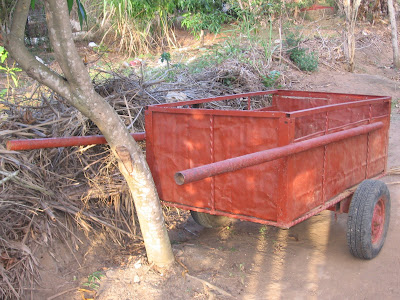
Many of them are wood, but this one is metal for extra durability. It was also great practice ahead of constructing a trailer for the tractor to helping with harvesting and general transport, which is slowed slightly while searching for an axel with a differential, which we identified as necessary for the stability of the trailer given the terrain it will be traversing.
In a recent blog entry titled “Life Changing,” I described, among other things, that nearly everything is reused, and the materials for this handcart were no exception; only welding rods and paint were purchased at this time. The axle and wheels are from an old wooden cart, the rods for the frame are reappropriated from something else, and you may or may not be able to tell, but all the flat sheets on the bottom and sides are cut and flattened 55-gallon drums. You know, the ones commonly used in the US as trash cans at parks and such.

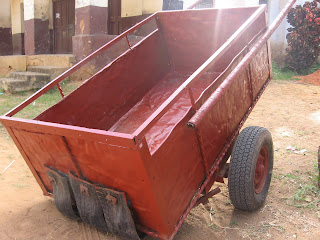
This handcart is very useful in the community for helping fetch water in 20-liter jugs, as well as other materials. There has been a water shortage lately that we have even felt; our host has enormous water storage tanks that he thought would keep us from realizing any water problems, but when he needed to refill them the local waterline had been broken by elephants that were looking for water several towns away. We have been able to fetch water from his well for washing (we buy pure drinking water), but we have seen ladies along the road carrying a full 20-liter jug balanced on their head (probably like 40lbs - I don't know how they do that!) from watering holes and boys on bikes can manage 3 of the jugs, but this cart has already allowed them to fetch a lot more in a single trip.
[Update: I saw it in use with one teenaged boy pulling it by the handles and about 6 younger boys around the sides and back kind of helping push. They had 7 or 8 of the water jugs, which the younger boys probably wouldn't have been able to carry theirs once filled. The cart was serving its purpose!]
Many of them are wood, but this one is metal for extra durability. It was also great practice ahead of constructing a trailer for the tractor to helping with harvesting and general transport, which is slowed slightly while searching for an axel with a differential, which we identified as necessary for the stability of the trailer given the terrain it will be traversing.
In a recent blog entry titled “Life Changing,” I described, among other things, that nearly everything is reused, and the materials for this handcart were no exception; only welding rods and paint were purchased at this time. The axle and wheels are from an old wooden cart, the rods for the frame are reappropriated from something else, and you may or may not be able to tell, but all the flat sheets on the bottom and sides are cut and flattened 55-gallon drums. You know, the ones commonly used in the US as trash cans at parks and such.
We pounded them flat with a mallet and then cut them 1 inch at a time with a chisel and the mallet. We also cut a worn out steel-belted tire with a hacksaw for the “brakes” at the back, which are installed reusing some nuts and bolts with some homemade washers from left over sheet metal.
This handcart is very useful in the community for helping fetch water in 20-liter jugs, as well as other materials. There has been a water shortage lately that we have even felt; our host has enormous water storage tanks that he thought would keep us from realizing any water problems, but when he needed to refill them the local waterline had been broken by elephants that were looking for water several towns away. We have been able to fetch water from his well for washing (we buy pure drinking water), but we have seen ladies along the road carrying a full 20-liter jug balanced on their head (probably like 40lbs - I don't know how they do that!) from watering holes and boys on bikes can manage 3 of the jugs, but this cart has already allowed them to fetch a lot more in a single trip.
[Update: I saw it in use with one teenaged boy pulling it by the handles and about 6 younger boys around the sides and back kind of helping push. They had 7 or 8 of the water jugs, which the younger boys probably wouldn't have been able to carry theirs once filled. The cart was serving its purpose!]
Subscribe to:
Posts (Atom)